Loading...
Industrial polyacrylamide (PAM) polymers are high molecular weight water-soluble polymers used as flocculants, coagulant aids, retention aids, and sludge conditioners in a wide range of water treatment and industrial processing applications. They work by bridging individual colloidal particles or floc aggregates into larger, denser flocs that settle rapidly under gravity or are easily separated by centrifugation, belt press, or filter press dewatering.
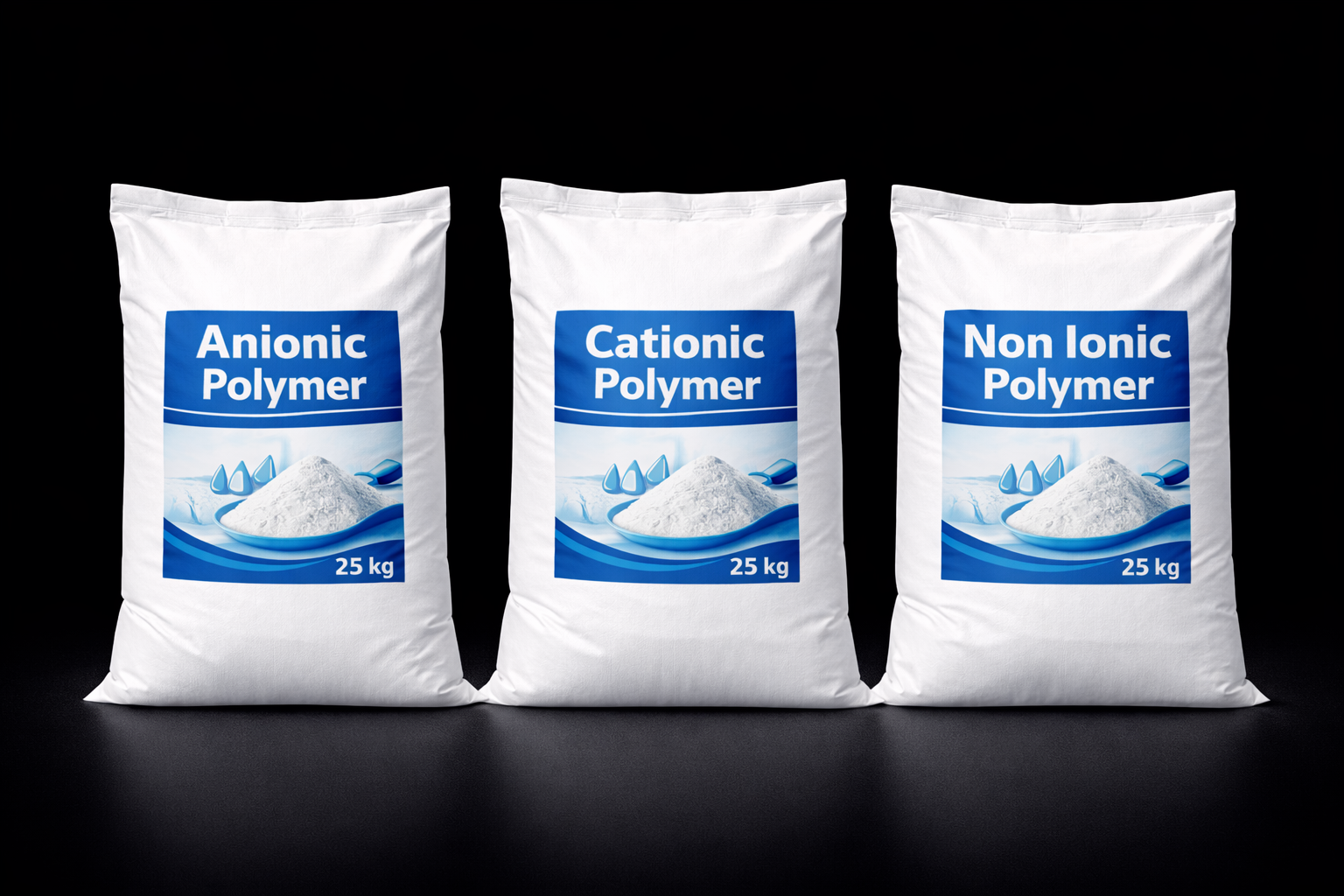
Cleanex Chemicals supplies anionic polyacrylamide (APAM), cationic polyacrylamide (CPAM), and non-ionic polyacrylamide (NPAM) in both powder (granular) and emulsion forms, covering a range of molecular weights (5-20 million Daltons) and charge densities to match specific application requirements.
Selection guide: Anionic polymers are suitable for mineral slurries and ETP sludge; cationic polymers are best for municipal and organic sludge; non-ionic polymers work well in acidic conditions and for coal washery applications.
| Polymer Type | Application | Industry |
|---|---|---|
| Anionic (APAM) | Mineral slurry settling, ETP sludge thickening | Mining, ETP, Ceramics |
| Cationic (CPAM) | Municipal sludge dewatering, paper stock retention | STP, Paper & Pulp, Food |
| Non-ionic (NPAM) | Coal washery effluent, acidic effluent clarification | Mining, Chemical |
| High MW Anionic | Red mud settling, coal tailings, bauxite residue | Alumina, Mining |
| High MW Cationic | Belt filter press and centrifuge dewatering | ETP, Municipal, Food Processing |
| Grade | Type | Molecular Weight (Da) | Charge Density | Dissolution Time |
|---|---|---|---|---|
| APAM-L | Anionic | 5 - 8 million | Low (10-20%) | 30 - 45 min |
| APAM-H | Anionic | 15 - 20 million | High (30-40%) | 45 - 60 min |
| CPAM-L | Cationic | 5 - 8 million | Low (10-30%) | 30 - 45 min |
| CPAM-H | Cationic | 8 - 12 million | High (40-80%) | 45 - 60 min |
| NPAM | Non-ionic | 10 - 15 million | Non-ionic | 30 - 45 min |
| Packaging | 25 kg multi-wall paper bags (powder); 200 L drums (emulsion) | |||
Share your sludge / effluent characteristics and we will recommend the optimal polymer type and dosage.